Category: Short/Opinion

  • 2. Why OT Deserves More Recognition

    2. Why OT Deserves More Recognition

    7-minute read

    Heads up! This post may include affiliate links, which means I might earn a small commission (at no extra cost to you) if you decide to make a purchase. I only share things I truly find helpful—thanks for supporting the blog!

    Introduction: More Than Just “Fine Motor Skills”

    Ever wonder why occupational therapy (OT) always flies under the radar compared to physical therapy or speech therapy? While everyone seems to know what a PT or SLP does, occupational therapists are still explaining that no, they don’t just help people “get jobs.” The truth? Occupational therapy plays a crucial, often life-changing role in helping people of all ages regain independence, improve their quality of life, and thrive in their daily routines—physically, mentally, and emotionally. Yet despite its impact, OT doesn’t always get the recognition it deserves.

    Let’s change that.


    What Is Occupational Therapy, Really?

    At its core, occupational therapy is all about helping people participate in the activities—or occupations—they need or want to do every day. That includes everything from brushing teeth to going to school or work, managing medications, and even engaging in leisure hobbies.

    Occupational therapists (OTs) assess individual needs and design intervention plans tailored to support independence and functional participation. Whether it’s helping a child with autism build sensory tolerance or guiding a stroke survivor in relearning daily tasks, OTs bring science, compassion, and creativity to every session.

    🔗 Learn more from the AOTA: What is Occupational Therapy?


    What Do Occupational Therapists Actually Do?

    Depending on the setting, occupational therapists wear many hats:

    • In pediatrics, they work with children on fine motor skills, sensory regulation, and adaptive play.
    • In hospitals, they support patients recovering from surgeries, injuries, or medical conditions to regain function.
    • In rehabilitation centers, OTs are a key part of interdisciplinary teams helping patients return to independence after events like strokes or traumatic brain injuries.
    • In mental health settings, OTs use therapeutic activities to promote coping strategies, social engagement, and self-care routines.

    Their role may include:

    • Environmental modifications
    • Adaptive equipment training
    • Cognitive therapy
    • Sensory integration
    • Task analysis and skill-building

    Don’t Forget OTAs: The Unsung Heroes

    What is an occupational therapy assistant? These licensed professionals work directly under OTs to implement treatment plans, often developing strong, day-to-day relationships with clients. OTAs are vital to the therapy process and are trained in intervention techniques, documentation, and therapeutic use of activities.

    💡 Bonus: The OTA career path is a fantastic option for those looking to enter healthcare with a more flexible timeline and educational cost than a master’s program.


    Specialized Areas: From Autism to Hand Therapy

    One of the most versatile things about OT is its scope.

    • Occupational therapy for autism often focuses on sensory processing, emotional regulation, communication, and daily routines.
    • Hand therapists (OTs with advanced training) specialize in post-surgical rehabilitation and orthopedic recovery.
    • Geriatric OTs help aging adults maintain independence and prevent falls.
    • School-based therapists support students with IEPs to thrive academically and socially.

    OTs are not just generalists—they are problem-solvers with clinical reasoning and a human-centered approach.


    Occupational Therapist Job Description & Career Outlook

    An occupational therapist’s job description includes:

    • Evaluating clients’ needs
    • Designing and updating treatment plans
    • Coordinating care with healthcare teams
    • Documenting progress
    • Educating caregivers or families

    So… is occupational therapy a good career? Absolutely.

    • Job Outlook: The U.S. Bureau of Labor Statistics predicts a steady job growth rate of 12% for OTs from 2022 to 2032.
    • Flexibility: OTs work in hospitals, schools, home health, early intervention, and even telehealth.
    • Salaries: Median pay for OTs in the U.S. hovers around $93,000/year (2023 data), and OTAs average $64,000/year.

    🔗 BLS OT Career Stats


    Why Isn’t OT Better Known?

    A few reasons:

    • Confusion around the term “occupational”
    • Lower visibility in media and pop culture
    • Lack of awareness in school guidance counseling and general healthcare marketing

    But the tide is turning. OTs are advocating harder than ever. Social media, blogs, and grassroots awareness campaigns are helping push OT into the spotlight.


    The Future of OT: Innovation and Advocacy

    Occupational therapy continues to expand into:

    • Telehealth and digital health tools
    • Community health and wellness
    • Global health initiatives
    • Advanced certifications and research

    We’re seeing more OT entrepreneurs, private practices, and product creators than ever before.

    As the world learns more about holistic health, function, and mental well-being—OT is ready to lead.


    Conclusion: OT Deserves the Spotlight

    Occupational therapy is often the quiet force behind major life transformations—yet it remains overlooked. Now’s the time to amplify its voice.

    Whether you’re a student, a caregiver, or simply curious about rehab professions, consider taking a deeper look into OT. You might just discover the most rewarding path you never knew existed.


    ✅ Download Your Free OT, PT, and ST Quick Reference Sheets

    Get free 1-page therapy reference sheets designed for rehab professionals or curious learners. Each sheet breaks down common interventions, settings, and tools of the trade.

    Subscribe and Download our free Rehab Therapy Quick Reference Sheets

    Be sure to subscribe to our newsletter and keep an eye out for our OT Pocket Guide (April)ST Pocket Guide (May), and PT Pocket Guide (October)—each packed with clinical tools, checklists, and intervention-based tips for everyday use.

    Originally posted 2025-04-24 03:00:00.
  • 12. How SLP, OT, and PT Work Together: Interdisciplinary Rehab for Stronger Patient Recovery

    12. How SLP, OT, and PT Work Together: Interdisciplinary Rehab for Stronger Patient Recovery

    When my grandmother had her stroke, I remember seeing three different therapists walk into her room—one after the other. First came the speech therapist, then the occupational therapist, and finally the physical therapist. They were kind, knowledgeable, and patient. But what really amazed me was how they worked together like a well-oiled machine.

    That experience opened my eyes to something that too often goes unnoticed in healthcare: the power of collaboration in rehabilitation. Individually, each therapist brings essential expertise to the table—but when they unite, SLP, OT, and PT become a force for transformational recovery.

    Let’s take a deeper look into why interdisciplinary teamwork is not just ideal—but essential—for patient-centered care.

    💡 Affiliate Disclosure: This post may contain affiliate links. If you click and purchase, I may earn a small commission at no extra cost to you. As an Amazon Associate, I earn from qualifying purchases. I only recommend tools I trust and use.


    🧠 What Is Interdisciplinary Rehab—and Why Does It Matter?

    Visual explaining interdisciplinary rehab team mode

    In interdisciplinary rehab, therapists from different specialties—speech-language pathologists (SLPs), occupational therapists (OTs), and physical therapists (PTs)—collaborate with a shared treatment plan. Unlike a multidisciplinary approach, where each discipline works in parallel, interdisciplinary teams coordinate in real-time to improve patient outcomes, reduce therapy overlap, and enhance communication.

    This approach leads to:

    • More cohesive goal-setting
    • Fewer redundancies in care
    • Better progress tracking
    • Enhanced patient satisfaction

    📌 According to the World Health Organization, integrated rehab services improve function, reduce hospital stays, and support long-term independence.


    🤝 The Unique Role Each Therapist Plays

    Three therapists providing different forms of rehab

    Let’s break down what each professional brings to the table—and how they complement one another.

    🗣 Speech-Language Pathologist (SLP)

    Focus: Communication, cognition, swallowing

    • Assess and treat speech/language deficits
    • Manage swallowing disorders (dysphagia)
    • Support cognitive-linguistic therapy

    Helpful Tool:
    👉 Low-Tech AAC Flip Book – ideal for collaborative bedside communication
    👉 Speech Therapy Mirror – great for articulation work during co-treatment sessions

    ✋ Occupational Therapist (OT)

    Focus: Functional independence and daily living

    • Help with dressing, grooming, and adaptive techniques
    • Address sensory processing, fine motor skills
    • Facilitate postural alignment for communication and feeding

    Helpful Tool:
    👉 Therapy Putty for Hand Strengthening
    👉 Weighted Lap Pad for Sensory Regulation

    🦵 Physical Therapist (PT)

    Focus: Mobility, strength, balance

    • Assist in walking, transferring, and body mechanics
    • Build endurance and coordination
    • Promote safety with ADLs and mobility devices

    Helpful Tool:
    👉 Regular Gait Belt
    👉 Balance Pad for Rehabilitation


    🔄 How Interdisciplinary Teams Collaborate in Practice

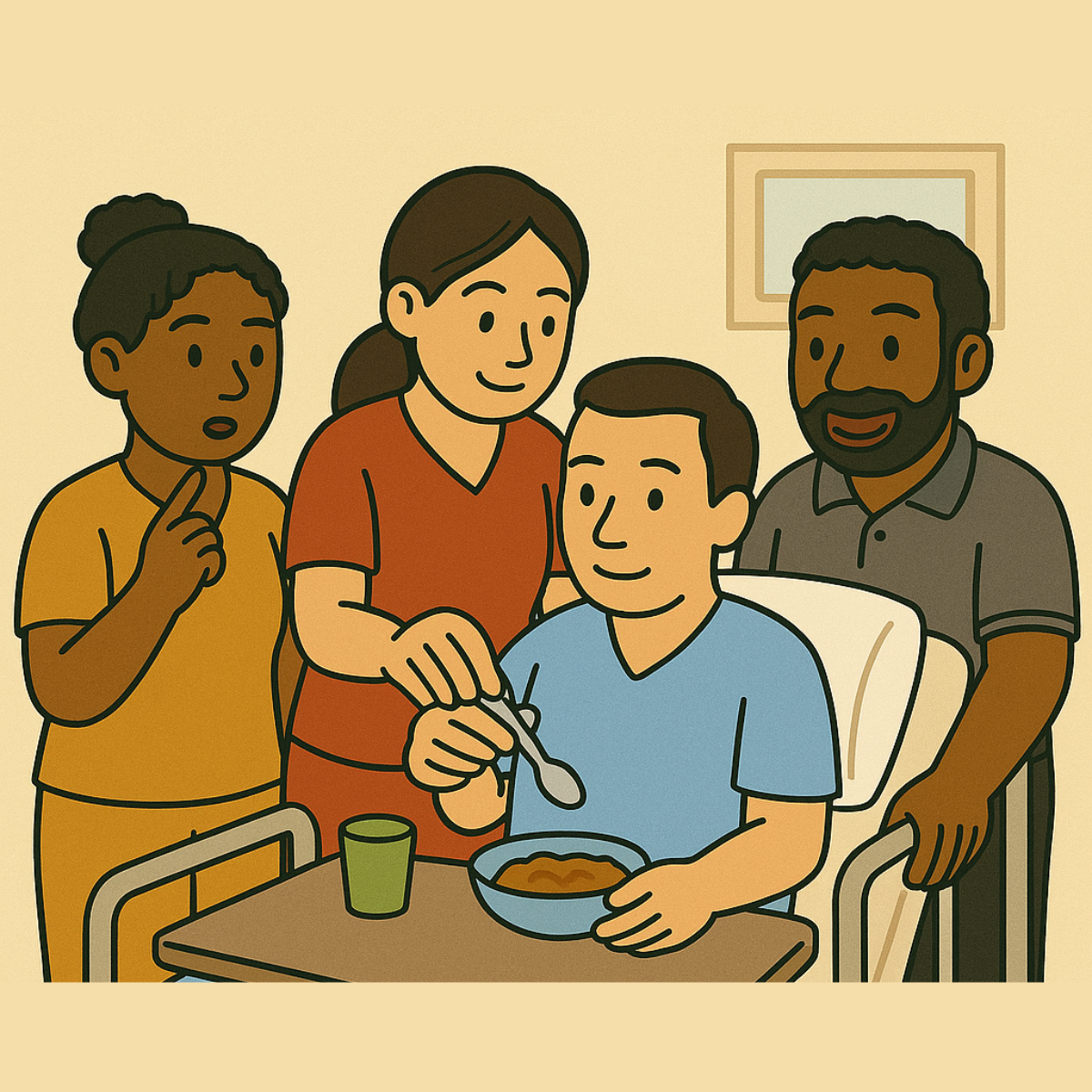
    Interdisciplinary co-treatment with patient during mealtime

    Here’s how this looks in action:

    • During a co-treatment, an SLP might work on cognitive sequencing while the OT facilitates a grooming task.
    • PT could position the patient safely for feeding, while the SLP assesses swallowing.
    • All three may meet weekly to align their goals, adjust interventions, and celebrate progress as a team.

    Shared Tools for Coordination:
    👉 Whiteboard Clipboard – great for writing down goals during sessions
    👉 HIPAA-Compliant Therapy Notebooks – excellent for coordinated care notes
    👉 Rehabilitation Team Communication Board – visual support for patients and team


    💪 Why Teamwork Improves Patient Outcomes

    Therapists supporting patient success as a team

    When therapists collaborate, the patient:

    • Receives comprehensive care that treats the whole person, not just one issue
    • Feels more supported, seen, and empowered
    • Shows faster and more sustainable progress
    • Gains consistent reinforcement across therapies

    A 2018 review published in the Journal of Rehabilitation Medicine emphasized that interdisciplinary teamwork is essential in physical and rehabilitation medicine, improving not only functional outcomes but also communication, patient satisfaction, and long-term success. By sharing goals, coordinating strategies, and delivering cohesive care, SLPs, OTs, and PTs can dramatically enhance a patient’s quality of life—especially in complex rehab scenarios.


    📚 Resources for Continued Learning


    🧡 Conclusion: Together, We Heal Faster

    Recovery isn’t linear—and it’s certainly not solitary. When SLPs, OTs, and PTs work together, the road to healing becomes smoother, faster, and more empowering for everyone involved.

    Whether you’re a therapist, student, caregiver, or patient—recognize the value of collaboration in every step toward independence.


    📥 Want Free Therapy Tools at Your Fingertips?

    3 Quick sheets available: OT,PT & SLP

    Download your free quick reference sheets for OT, PT, and ST—perfect for therapists, students, or anyone in the field.

    📘 OT Pocket Guide available now


    📕 ST Pocket Guide releasing soon
    📗 PT Pocket Guide launching in October

    👉 Download Your Free Quick Sheets


    💬 We Want to Hear From You

    Therapists sharing feedback and goals together

    Have you ever seen a great therapy team in action? What made the difference?

    👇 Share your story in the comments—we learn best when we learn together.

    Originally posted 2025-05-29 05:39:05.