Category: Tips/Resources

  • 20. The Hidden Effects Of 2025’s New Professional Degree Rule

    20. The Hidden Effects Of 2025’s New Professional Degree Rule

    It hit like a bombshell on social media: “Nursing isn’t a professional degree anymore.” For many therapists — PTs, OTs, SLPs — and nurses hoping to advance their training, that message sparked fear. Would your DPT, MOT/OTD, or MSN stop counting? Would student loans dry up? As someone working in rehab (and planning content around PT/OT/SLP), I knew I had to dig deeper. Let’s walk through what’s really happening — the policy, the politics, and what it means for you, as of December 1, 2025.

    TL;DR — What You Need to Know

    In 2025, the U.S. Department of Education proposed narrowing the definition of “professional degrees” for federal loan purposes, not for licensure. Degrees in Nursing, PT, OT, SLP, PA, Public Health, Social Work, and more would be categorized as graduate degrees, losing access to the highest federal borrowing limits.

    What this does not change:
    – Your degree title
    – Your license or scope of practice
    – Accreditation of PT/OT/SLP/Nursing programs
    – Existing loan forgiveness already granted

    What it does change:
    – Reduces federal borrowing caps for many healthcare graduate programs
    – Pushes more students toward private loans, scholarships, or out-of-pocket funding
    – Raises concerns about workforce shortages and equity

    These are the verified facts as of December 1, 2025. This summary will not reflect future updates until official rulings are finalized in 2026.

    ⚠️ Medical Disclaimer: This post is meant to be educational and informational — and maybe even a little fun. If you want real answers, talk to a real person (a licensed healthcare provider or financial aid advisor) — this post can’t evaluate, diagnose, or treat.

    Calendar highlighting July 2024 beside a laptop displaying the U.S. Department of Education announcement.

    What Changed in 2025 — and Why It’s Getting So Much Attention

    In late 2025, the U.S. Department of Education (ED) — under the recently passed One Big Beautiful Bill Act (OBBBA) — proposed a sweeping redefinition of what counts as a “professional degree.” NBC4 Washington+2U.S. Department of Education+2

    Under this new classification, many graduate-level degrees — including those for nursing, physical therapy, occupational therapy, speech-language pathology, physician assistants, and others — would no longer be labeled “professional degree programs.” NBC4 Washington+2Spectrum News 1+2

    Why? According to the Department, the redefinition is tied to new limits on federal student borrowing. Only “professional program” students — e.g. medicine, law, pharmacy, dentistry — get the highest borrowing cap. Other graduate-level students (in excluded fields) face stricter limits. U.S. Department of Education+2Statesman+2

    The official regulatory shift comes as part of broader efforts under OBBBA and the associated Financial Value Transparency and Gainful Employment regulations, which began implementation July 1, 2024. FSA Partner Connect+1


    Visual representation of rising healthcare student debt compared to stable income levels.

    What “Professional Degree” Meant — and What It Means Now

    Historically, a “professional degree” under ED’s guidelines referred to degrees preparing individuals for licensure-based, often independent-practice professions — medicine (M.D.), dentistry (D.D.S./D.M.D.), law (J.D.), pharmacy, etc. U.S. Department of Education+2Nurse.com+2

    With the new rule, ED narrowed that list dramatically. The degrees still included as “professional”: medicine, pharmacy, dentistry, optometry, law, veterinary medicine, osteopathic medicine, podiatry, chiropractic, theology, and clinical psychology. NBC4 Washington+2Yahoo+2

    Excluded from the list are nursing (MSN, DNP, NP), physical therapy (DPT), occupational therapy (MOT/OTD), speech-language pathology, physician assistant, public health — and several non-health fields like social work, education, architecture, etc. NBC4 Washington+2Newsweek+2

    Important: This redefinition is for federal loan eligibility and borrowing limits. It is not a professional licensure or accreditation decision. ED clearly states that excluding a program from “professional degree” status in loan rules is not a value judgment on its legitimacy or importance. U.S. Department of Education+1


    Icons representing PT, OT, SLP, and nursing to show which professions are impacted by federal classification changes.

    Who This Affects — PT, OT, SLP, Nursing, and More

    • Graduate students (current & future) in PT, OT, SLP, nursing (MSN / DNP / NP), physician assistant, public health, social work, etc. The reclassification affects their eligibility for high-limit federal loans. NBC4 Washington+2WPR+2
    • New applicants (2026 onward) — under the soon-to-be effective loan caps and redefinition — are most vulnerable to reduced federal borrowing power. Spectrum News 1+1
    • Current students Who’ve Already Borrowed — their existing degrees remain valid; licensure and accreditation are unaffected. The change does not retroactively strip credentials.

    According to the American Physical Therapy Association (APTA), the proposed redefinition of DPT (and other health-care degrees) as merely “graduate,” not “professional,” threatens physical therapy’s recognition as a doctoring profession — potentially harming future workforce supply. American Physical Therapy Association

    Similarly, the American Nurses Association (ANA) has publicly condemned the move, warning that cutting access to robust federal loan support will worsen nursing shortages — especially in underserved communities. ANA+2The Independent+2


    Side-by-side silhouettes of healthcare students and a working clinician to show the difference in who is affected.

    What It Means for Student Loans & Financing Your Degree

    Under the new rules:

    • Graduate students in excluded programs (nursing, PT, OT, etc.) would qualify for a lower borrowing cap: $20,500 per year, with a $100,000 lifetime capNBC4 Washington+2Campus Reform+2
    • “Professional degree” students — those in ED’s narrow list — remain eligible for higher borrowing limits: up to $50,000 per year, and a $200,000 aggregate capCBS News+2U.S. Department of Education+2
    • This dramatically reduces the amount of guaranteed federal funding for many prospective therapists, nurses, and related professionals.

    Implications:

    • Students may need more out-of-pocket fundsprivate loans, or scholarships to afford grad school.
    • Higher debt burden may discourage people from entering these fields — potentially worsening workforce shortages.
    • Schools may feel pressure to lower tuition or rework funding models — but these are long-term effects, not guaranteed solutions.

    It’s important to note: the change doesn’t impact undergraduate degrees (BSN, BSc-OT, etc.). Those remain unaffected under current guidance. U.S. Department of Education+1


    What This Doesn’t Change — Licensure, Accreditation & Professional Identity

    • If you already have a DPT, MOT/OTD, MS-SLP, MSN, or similar degree, your license, credentials, and right to practice remain valid.
    • Accreditation bodies for PT, OT, SLP, Nursing, etc., are unaffected by ED’s financial-aid classification.
    • The clinical scope of practice, state licensure boards, and employer credentialing are not governed by ED’s loan-classification rules.

    So while the new classification is financially significant, especially for future students, it does not mean these professions are no longer “real” or “legitimate.”


    a person reviewing federal student loan repayment options on a laptop.

    Different Viewpoints & Controversy Around the Change

    Some people argue the new definition is just bureaucratic housekeeping — meant to curb excessive student borrowing and hold programs accountable. Indeed, ED claims that the “professional degree” label was always meant for a narrow set of high-cost, high-return vocations. U.S. Department of Education+1

    But many in the healthcare community see it differently:

    • Nursing associations warn this move could widen existing workforce shortages, especially in rural and underserved areas. ANA+2WPR+2
    • The APTA says it undermines the recognition of physical therapy as a “doctoring profession” — which could reduce interest in PT graduate education. American Physical Therapy Association
    • Some critics frame the change as a gender-biased decision, given many excluded professions are female-dominated, which may disproportionately impact women and further reduce diversity in healthcare. World Socialist Web Site+2WPR+2

    Although ED says the change is neutral, the ripple effects in education access, diversity, and workforce capacity are likely to be substantial.


    Timeline graphic showing implementation phases from classification to reporting to enforcement between 2024 and 2026.

    What You Should Do (If You’re a Student, Pre-PT/OT/SLP, or Future Clinician)

    • Reassess your financing plan — don’t assume Graduate PLUS or large federal loan packages will be available.
    • Consider supplemental funding: scholarships, grants, part-time work, private loans, or employer-sponsored loan support.
    • Track ED’s rulemaking timeline — final rules expected by mid-2026. ASPPH+2FSA Partner Connect+2
    • Advocate — if you care, reach out to professional associations (e.g. APTA, ANA) to support voices urging preservation of fair loan access.

    Helpful Resources for Navigating the 2025 Degree & Loan Changes

    Because these federal updates affect how future PT, OT, SLP, and Nursing students access funding, many applicants and current students are looking for ways to study effectively, stay organized, and financially prepare for graduate school. Below are several resources that align with the theme of this post — focusing on smart planning, efficient studying, and financial readiness during a time of stricter lending rules.

    📘 Academic & Exam Prep Support (Non-Affiliate)

    If you’re aiming to strengthen your academic foundation before taking on additional debt, certain study platforms can reduce stress and improve board-prep efficiency.
    One of the most helpful tools for me personally was PassTheOT.com, which supported me through my OTA/COTA exam preparation. (I’m not affiliated with them at the time of writing — just sharing what genuinely helped me succeed.)

    For PT and SLP students, I recommend checking reputable exam-prep sites, updated NPTE and Praxis-SLP review platforms, and APTA’s official guidance to ensure your study material reflects the newest exam standards.

    These aren’t affiliate links — just practical supports for students who want to maximize success without unnecessary spending.


    💰 Financial Tools to Stay Ahead of New Loan Limits

    With federal borrowing caps tightening, understanding your finances is more important than ever. A good budgeting planner can help track tuition payments, deadlines, and living expenses as you balance reduced loan availability
    — you can explore one here:
    Budgeting Planner.

    If you’re new to understanding federal loans, interest, repayment plans, or private alternatives, reading solid financial-literacy books specifically geared toward student loans can make the entire process less stressful:
    Financial Literacy Books.


    🎓 Grad School Essentials for Better Focus & Organization

    For many students, particularly in rehab therapy and nursing, time management becomes crucial when balancing classes, labs, clinicals, and part-time work (which may be more common due to lower loan caps). A high-quality academic planner can help you stay structured and intentional with your schedule.

    If you tend to study in busy environments (shared housing, cafeterias, hospital lounges), noise-canceling headphones can make a huge difference in your focus:
    Noise-Canceling Headphones.


    🩺 Clinical Tools to Support Efficiency in Rotations & Early Practice

    Once you reach the clinical phase of your program, the right gear becomes essential. Long hours on your feet — especially in PT, OT, SLP, and Nursing — require reliable footwear. Students consistently recommend supportive brands like HokaOn Cloud, and Brooks, which you can explore here:

    If your program requires on-the-go documentation or bedside note-taking, a HIPAA-compliant storage clipboard can help keep papers secure while making evaluations easier:
    Storage Clipboard.

    Clinical measurement tools (like goniometers, pulse oximeters, or stopwatches) are also worth considering if your program encourages you to build your own practical toolkit.


    Graduation cap and stethoscope resting on a wooden table with a softly blurred bookshelf in the background.

    Final Thoughts

    This redefinition by the Department of Education is a big deal for future students — particularly those entering PT, OT, SLP, nursing, and similar fields. But it’s also a bureaucratic/financial shift — not a professional downgrade.

    If you already have your license or are currently practicing, nothing about your professional identity changes. But if you’re thinking about going back to school, now’s the time to re-examine your financing plan, consider scholarships or alternate funding, and be prepared for tighter borrowing limits.

    I’ll continue tracking developments as the final rules roll out (expected mid-2026). In the meantime, sign up for my free quick-reference sheets and guidebooks — and stay on top of changes that could affect your future as a clinician.

    Question for the readers:
    If you were planning to go back for an advanced degree in PT, OT, SLP, or Nursing — would this change make you hesitate? Or would you still apply and find alternate funding? Drop your thoughts in the comments — I’m curious what others are thinking.

  • 9. Feeding Therapy 101: Tips for SLPs Just Starting Out

    9. Feeding Therapy 101: Tips for SLPs Just Starting Out

    7-minute read

    That First Feeding Case Feeling…

    You walk into the therapy room, spoon in one hand, visual schedule in the other—and there’s a toddler across from you turning their head, refusing every bite. Your first instinct? Panic. But here’s the truth: if you’re a new speech-language pathologist (or SLPA) stepping into feeding therapy, you’re not alone in feeling unsure.

    Feeding therapy is incredibly rewarding, but it’s also complex. You’re not just helping a child eat—you’re supporting their sensory development, oral motor skills, emotional regulation, and family dynamics. It can feel overwhelming at first—but with the right tools, guidance, and mindset, you can thrive.

    Starting your feeding therapy journey as an SLP? This guide simplifies what you need to know—from essential tools and tips to trusted strategies and credible resources—so you can confidently support pediatric feeding and swallowing. Plus, get our free therapy quick sheets to use during sessions.

    Affiliate Disclosure: As an Amazon Associate, I earn from qualifying purchases. This means if you click a link and purchase a product, I may earn a small commission—at no extra cost to you. I only recommend tools I believe are valuable to therapy practice.

    Let’s dive in.


    What Is Feeding Therapy, Really?

    Feeding therapy materials used by SLPs

    Feeding therapy goes far beyond “getting kids to eat more.” As a speech-language pathologist, you’re trained to evaluate and treat the underlying skills needed for safe, efficient, and enjoyable feeding.

    That includes:

    • Strengthening oral motor skills for chewing and swallowing
    • Managing sensory sensitivities or aversions
    • Encouraging variety and volume in food acceptance
    • Educating families on pacing, cues, and realistic goals
    • Collaborating with interdisciplinary team members when necessary

    Feeding therapy may look different across settings—from NICU follow-ups to early intervention home visits—but the principles remain the same: safe intake, skill building, and caregiver involvement.

    For a foundational overview, explore ASHA’s Pediatric Feeding and Swallowing Guidelines


    Start with the Right Tools

    Beginner feeding therapy tools for pediatric SLPs

    The good news? You don’t need a closet full of expensive gadgets. Here are some beginner-friendly, trusted tools you’ll likely use often:

    • ARK Z-Vibe: A must-have oral motor tool for sensory input and pre-feeding exercises.
    • Chewy Tubes Set: Great for jaw strength, coordination, and reducing biting behaviors.
    • TalkTools Honey Bear Straw: Ideal for teaching controlled straw drinking with limited flow.
    • Maroon Spoons: A classic for safe, shallow spoon feeding.
    • ezpz Tiny Spoon Set: Soft silicone spoons that promote independence and reduce gag triggers.
    • Food Scissors: Help cut up food into manageable bites right before or during sessions.

    These tools help build oral tolerance, reduce sensory defensiveness, and support developmental readiness.


    Understand Oral Motor & Sensory Foundations

    SLP guiding oral motor development using therapy tools

    Before working on “what” to eat, SLPs must understand “how” the child processes food orally and sensory-wise. These foundational factors often explain many feeding challenges:

    • Weak jaw, lip, or tongue muscles
    • Hypersensitive gag reflex or aversive textures
    • Limited oral exploration or mouthing in infancy
    • Excessive drooling or messy mealtime behavior

    That’s where oral motor exercises and sensory-based strategies come in. You might use vibration for stimulation, chewy tubes for jaw stabilization, or soft spoons to build tolerance. Sessions should be playful, exploratory, and low-pressure.

    Curious about integrating sensory strategies? Check out the SOS Approach to Feeding


    Create a Consistent Mealtime Setup

    Structured mealtime setup in pediatric feeding therapy

    Children thrive on structure and predictability—especially when food is involved. Whether you’re working in a clinic, home, or school setting, try to keep the environment calm, familiar, and supportive.

    Here’s how:

    • Use a visual schedule or picture sequence to set expectations
    • Stick to the same feeding chair, plate, and utensils each time
    • Minimize distractions (no screens, bright lights, or loud noise)
    • Use adaptive tools like the ezpz Mini Mat to separate textures visually

    Remember: consistency doesn’t mean rigidity. It simply reduces the stress response and increases participation.


    Coach Caregivers with Compassion

    Speech therapist coaching parent on home feeding strategies

    Feeding issues often feel emotional for families. As an SLP, your role includes not just treating the child—but supporting the caregivers through education, validation, and realistic expectations.

    Help parents:

    • Recognize subtle cues (turning head, pushing away food)
    • Understand progress isn’t always linear
    • Use language like “Try this bite” instead of “You have to eat this”
    • Explore books like Helping Your Child with Extreme Picky Eating to reinforce strategies at home

    Caregiver involvement is one of the strongest predictors of feeding therapy success.


    Know When to Refer Out

    Collaborative team discussion for feeding therapy referrals

    Even experienced SLPs don’t do feeding therapy alone. Know your scope—and when to refer to others on the care team:

    • OTs – when posture, fine motor, or sensory processing issues are affecting feeding
    • Nutritionists – for growth concerns, calorie tracking, or restrictive diets
    • GI Specialists or ENTs – for signs of reflux, allergies, or structural concerns

    You’re not “giving up” by referring—you’re strengthening outcomes through collaboration.

    See this model in action via Stanford Children’s Interdisciplinary Feeding Program


    Your Confidence Will Grow With Every Bite

    Feeding therapy is dynamic. It’s messy, creative, and deeply rewarding. If you’re a new SLP starting out, remember: you don’t need to know everything on day one. Trust that your clinical skills, compassion, and continued learning will guide you.

    Start with one child. One tool. One small goal. The rest will come.


    Therapy Support You Can Use Right Now

    Grab your FREE Quick Reference Sheets for OT, PT, and ST—designed to help you during sessions with feeding tools, intervention ideas, and treatment tips.


    Looking for something more in-depth?
    Our growing series of therapy pocket guides offer expanded content, strategies, and printable tools for busy rehab professionals:

    📘 OT Pocket Guide — Available now

    🗣️ ST Pocket Guide — Releasing this month
    📅 PT Pocket Guide — Coming October


    Let’s Learn From Each Other

    Do you have a favorite feeding therapy tip or go-to tool for new SLPs? What helped you feel more confident when starting out?

    Drop your insights or questions in the comments below—we learn best when we learn together.

    Originally posted 2025-05-21 04:00:54.

  • 6. Helping Patients with ALS Communicate: 6 Tips from a Rehab Therapist

    6. Helping Patients with ALS Communicate: 6 Tips from a Rehab Therapist

    7-minute read

    This post contains affiliate links. If you purchase through these links, I may earn a small commission—at no extra cost to you. I only recommend tools I believe are helpful and relevant for patients, therapists, and caregivers.

    Introduction: When Words Become a Lifeline

    Losing the ability to speak is one of the most painful changes that can come with ALS. But communication doesn’t have to stop there—and it shouldn’t. For people living with ALS, being able to express themselves means holding onto their voice, their choices, and their identity.

    As a rehab therapist, I’ve seen firsthand how the right support can open doors to connection, even as speech becomes more difficult. Whether you’re a caregiver, therapist, or loved one, these six communication tips can help you support someone with ALS in ways that are both practical and deeply meaningful.


    Fast Facts About ALS

    ALS symptoms and age chart infographic

    Before we jump into the tools and strategies, let’s cover the basics:

    • What is ALS?
      ALS (amyotrophic lateral sclerosis) is a progressive neurodegenerative disease that affects nerve cells in the brain and spinal cord. It weakens voluntary muscles, including those needed for talking, eating, and moving.
    • Who gets ALS?
      Most people are diagnosed between ages 40 and 70, with the average age around 55. It’s rare, but can also affect younger or older individuals.
    • Is ALS always genetic?
      No. About 90–95% of cases are sporadic, meaning no known family history.
    • Does ALS affect the mind?
      In most cases, cognition is preserved—even as speech and mobility decline.
    • Does everyone with ALS lose their voice?
      Many do over time, especially with bulbar-onset ALS. But with tools and planning, communication can continue in different forms.

    Source: CDC ALS Facts

    Stages of ALS and Communication Changes

    Understanding where someone is in the ALS journey can help tailor communication support. Here’s a simplified breakdown:

    StageCommon SignsCommunication Support
    EarlyMild slurring, some limb weaknessWriting tools, letter boards, voice banking
    MiddleNoticeable speech and hand weaknessAAC devices, voice amplifiers
    LateSevere speech and mobility lossEye gaze systems, pre-programmed AAC tools

    1. Start Simple: Use Writing Tools and Communication Boards

    ALS patient using letter board to communicate

    In the early stages, speech may be slurred or tiring, but hand control is usually still intact. That makes low-tech tools like:

    a great place to start.

    Why it helps: These tools are quick, reliable, and allow people to express needs without complicated setup.

    Recommended Products:


    2. Make Their Voice Louder: Try a Voice Amplifier

    Voice amplifier being used to support ALS communication

    If someone’s voice becomes soft but still functional, a portable voice amplifier can help. It’s especially useful during family gatherings or doctor visits.

    Recommended Product:

    Therapist Tip: Test out different microphone positions and volumes to prevent feedback and make conversations easier for everyone.


    3. Use AAC Devices for Ongoing Communication

    AAC device being used by ALS patient with therapist support

    As ALS progresses, speech may become hard to understand—or disappear completely. That’s when AAC (Augmentative and Alternative Communication) steps in.

    AAC devices can include:

    Recommended Products:

    Need to Know: These tools work best when set up before communication becomes too limited. An SLP (speech-language pathologist) can guide the process.


    4. Go Hands-Free: Try Eye-Gaze or Head-Control Technology

    ALS patient using eye gaze to type message on screen

    When hand movement is no longer possible, tech doesn’t give up—it adapts.

    Eye-gaze systems and head-controlled mice let users move a cursor with their eyes or head and click to speak, type, or control their environment.

    Recommended Product (Head-controlled alternative):

    These systems can take some setup and training, but once in place, they empower full communication—even in advanced stages.


    5. Keep Using Devices with Adaptive Styluses

    Mouth stylus used to navigate communication app on tablet

    If a person can’t use their fingers but still has some upper body or head movement, adaptive styluses can help them use tablets and phones.

    Options include:

    • Mouth stick styluses
    • Head-mounted or hand-mounted styluses
    • No-touch capacitive styluses

    Recommended Products:


    6. Plan Ahead with Voice Banking

    ALS patient creating custom voice bank on laptop

    One of the most meaningful things a person with ALS can do early on is record their voice before it’s lost. This is called voice banking—and the recorded clips can later be used in speech-generating devices.

    Recommended Resources:

    This process lets them speak with their own voice, even when their body can’t.


    Conclusion: Your Voice Is Still Yours

    ALS takes away many things—but with planning, creativity, and care, communication doesn’t have to be one of them. Every person deserves to express who they are, what they want, and how they feel. Whether it’s a simple letter board or an eye-controlled tablet, there are always ways to stay connected.

    Download Your Free Rehab Therapy Quick Reference Sheets

    Grab our printable OT, PT, and ST cheat sheets—great for clinics, home visits, and caregivers!

    Need More Tools? Our Rehab Therapy Pocket Guides Are Here to Help

    • OT Pocket Guide – OUT NOW!
    • ST Pocket Guide – Coming This May
    • PT Pocket Guide – Coming This October

    Each guide is packed with checklists, tips, and real-world tools for therapists and caregivers.

    Originally posted 2025-05-08 12:52:33.

  • 16. Therapist Survival Guide: Hydration & Heat Precautions for Summer Visits

    16. Therapist Survival Guide: Hydration & Heat Precautions for Summer Visits

    ☀️ When the Heat Hits: Summer Isn’t Just a Patient Concern

    As rehab therapists, we pride ourselves on being adaptable—climbing stairs with stroke patients, running errands with someone regaining independence, or walking alongside a child during outdoor play therapy. But summer adds a layer of challenge, especially for those in home health or outpatient community-based care.

    If you’ve ever found yourself dripping with sweat between visits, chugging lukewarm water from your car, or trying to protect a splint from sun-exposed surfaces—you’re not alone. Summer safety isn’t just a comfort issue—it’s a clinical necessity for protecting therapists and clients from heat-related hazards.

    Let’s walk through key summer safety tips for rehab therapists so you can keep care consistent, safe, and hydrated.

    ⚠️ Affiliate Disclosure

    This blog contains affiliate links. As an Amazon Associate, I earn from qualifying purchases. This helps support the blog at no extra cost to you. I only recommend tools I’d use myself as a therapist in the field.


    🧊 Hydration Tips for Therapists on the Go

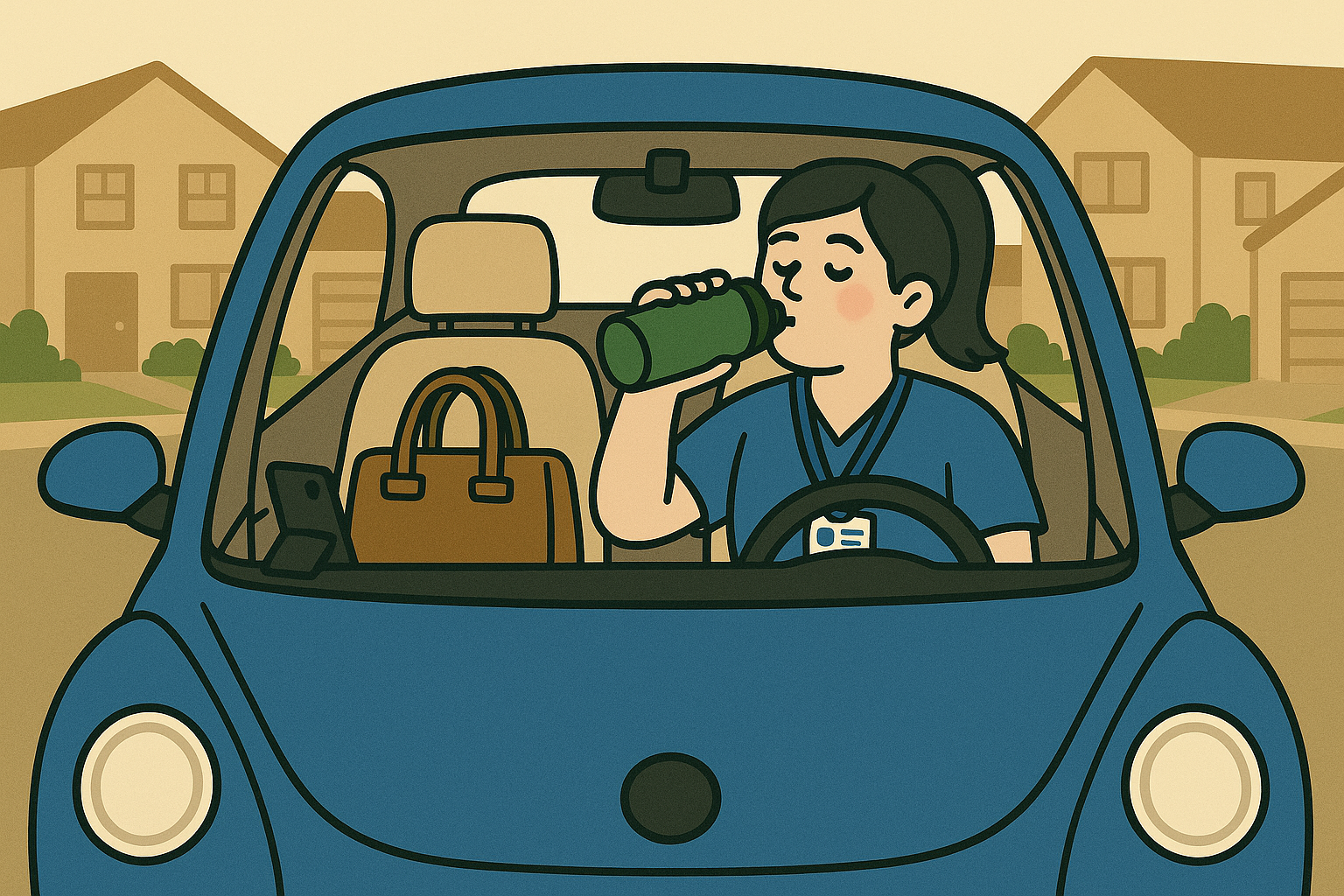
    Speech Therapist staying hydrated and fed between summer home visits

    Even mild dehydration can affect your energy, attention, and decision-making—none of which we can afford to compromise during a treatment session.

    Quick hydration strategies:

    • Keep electrolyte packets in your therapy bag for a quick fix when you’re sweating between visits.
    • Choose a quality insulated water bottle, like a Hydro Flask or ThermoFlask, to keep water cold all day—even in a hot car.
    • Set reminders to drink at least every hour on the road or during long sessions.

    Pro Tip: Some therapists mark their bottles with time goals or refill checkpoints—whatever keeps you sipping safely!


    🌞 Heat Precautions for Rehab Therapists

    Occupational Therapy Assistant using cooling towel to prevent heat exhaustion for herself and her client.

    Therapists are particularly vulnerable to heat exhaustion due to constant movement, car travel, and PPE use in homes that may lack air conditioning.

    Watch for:

    • Dizziness, rapid heart rate, or nausea
    • Confusion or heavy sweating
    • Unusually sluggish physical or cognitive performance

    Precaution checklist:

    📚 CDC Heat-Related Illness Prevention
    🧾 NIOSH Guide for Outdoor Workers


    🚗 Safe Summer Home Visits: From Car to Client

    Mobile therapist’s summer-ready car setup

    For home health therapists and traveling outpatient providers, your car is your mobile clinic. And it needs some summer prep too.

    Essential tips:


    🧴 Sun Protection for Outdoor Therapy Sessions

    Physical therapy assistant and client using sun protection during outdoor rehab

    Pediatric therapists, outdoor walkers, and those working on mobility re-integration often find themselves under direct sun.

    Your sun safety kit:

    🧪 Skin Cancer Foundation – Sun Protection


    🧰 Emergency Supplies for Mobile Clinicians

    An open red first aid kit displayed on an indoor table, with bandages, scissors, bottles, and two labeled instant cold packs placed in front of it.

    Therapists in the field may not always have immediate access to help. Be sure your summer gear includes:

    • first aid kit stocked for minor cuts, overheating, or allergic reactions
    • Instant cold packs for patient or therapist use during emergencies
    • Hydration, backup PPE, and temperature-sensitive tools are stored securely

    🧡 Final Thoughts: Stay Cool, Stay Clinical

    A beach scene with a towel, umbrella, cooler, and a spilled thermal water bottle on the sand, with ocean waves and a sunny sky in the background.

    Rehab doesn’t take a break for the heat—and neither do we. But with small adjustments and reliable tools, you can keep care consistent and avoid burnout this summer.

    Whether you’re sweating between home visits or supporting clients through outdoor goals, prepping for summer safety keeps everyone healthier.

    🧠 Want more therapy tools like this?
    📖 Download your free Quick Reference Sheets, and check out the 

    • Occupational Therapy Pocket Guide (available now),
    • the Speech Therapy version (coming soon!),
    • and the Physical Therapy edition (coming October 2025).

    💬 What’s Your Go-To Summer Tip?

    Drop your favorite hydration hack or summer-safe therapy tool in the comments below—we’d love to learn from you!

    Originally posted 2025-07-08 16:30:00.